

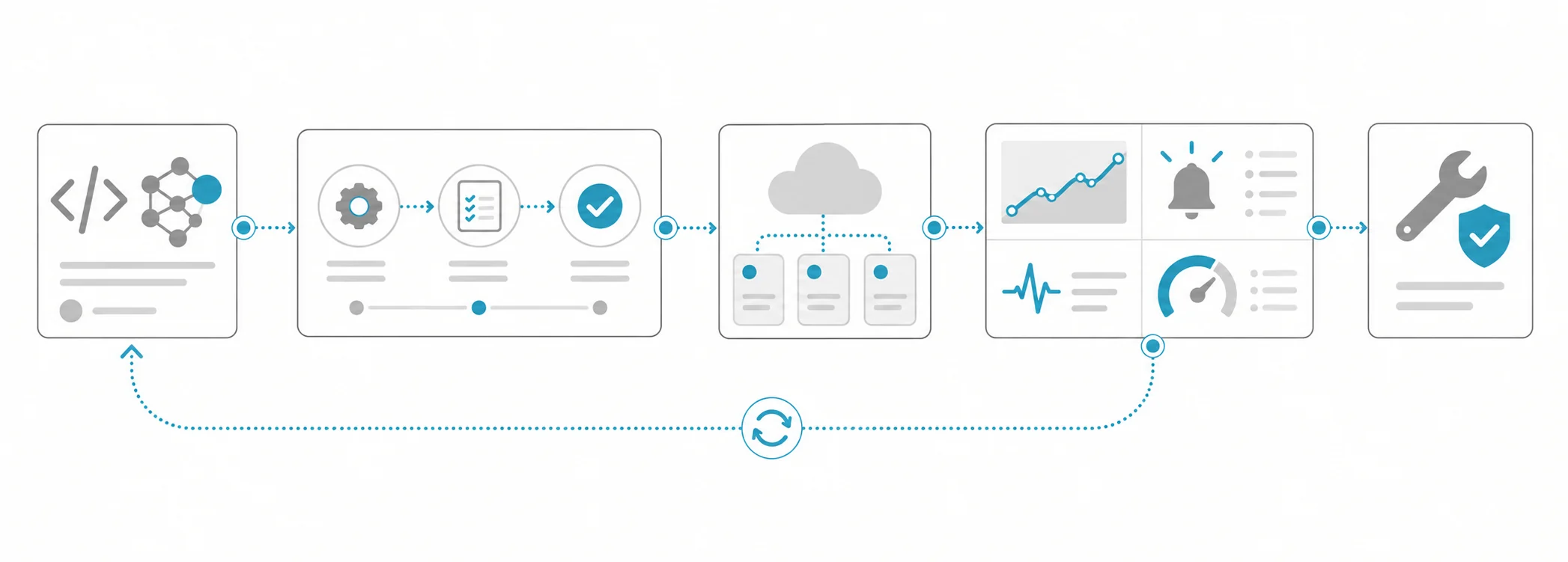
Pick one asset and failure
Choose an asset with recorded failures and meaningful maintenance lead time. Define what event counts as failure, which intervention can prevent it, and the earliest useful warning. Avoid modeling every machine and failure mode in the first pilot.
Join sensor and work-order data
Align readings, operating state, maintenance logs, and failure timestamps. Remove signals recorded only after an alarm or repair, or the model will learn the answer from the future. Record sensor gaps and replacements.
Use a time-based test
Train on earlier periods and test on later periods, preserving asset grouping where relevant. Report warning lead time, missed failures, and false work orders, not only classification accuracy. Compare against a simple threshold and current preventive schedule.
Fit the maintenance workflow
An alert needs an owner, inspection checklist, parts availability, and escalation time. Set separate bands for observation and immediate action. If technicians cannot act before failure, predictive accuracy alone has no operational value.
Run in shadow mode
Record predictions without altering the maintenance plan for a fixed period. Review every alert with engineers, including unpredicted failures. Promote to assisted decisions only after the model's lead time and workload prove useful. Joining maintenance logs and sensor history into a usable dataset is the big data and data engineering work that comes before any failure model.
Sensor and data feasibility checklist
| Check | Example evidence and decision |
|---|---|
| Failure definition | Example asset: one packaging motor. Define failure as an unplanned stop requiring repair, not every planned service. Record the event timestamp, repair start, and return to service so a warning window can be evaluated. |
| Sensor coverage | List vibration, temperature, current, operating state, and sampling interval actually available before failure. Mark gaps and sensor replacements. A signal recorded only after the breakdown must be excluded from the training window. |
| History | Count independent failures, not the number of sensor rows. If there are too few confirmed events, start with a rule-based alert and data collection rather than claiming a trained classifier can generalize. |
| Lead time | Illustrative operations requirement: maintenance needs four hours to obtain a part. Compare alert time with actual failure time and count warnings that arrived too late. A correct prediction five minutes before failure would not meet this workflow. |
| Shadow result | Run alerts without opening work orders for a fixed trial. For each alert, record technician finding, eventual failure, and unnecessary inspection time. Proceed only if prevented downtime plausibly exceeds alert workload and the missed-failure limit is acceptable. |
Technical references: scikit-learn documentation, Microsoft Learn documentation. Related guide. Check the cited documentation against your own data, permissions and release version before applying this design.