

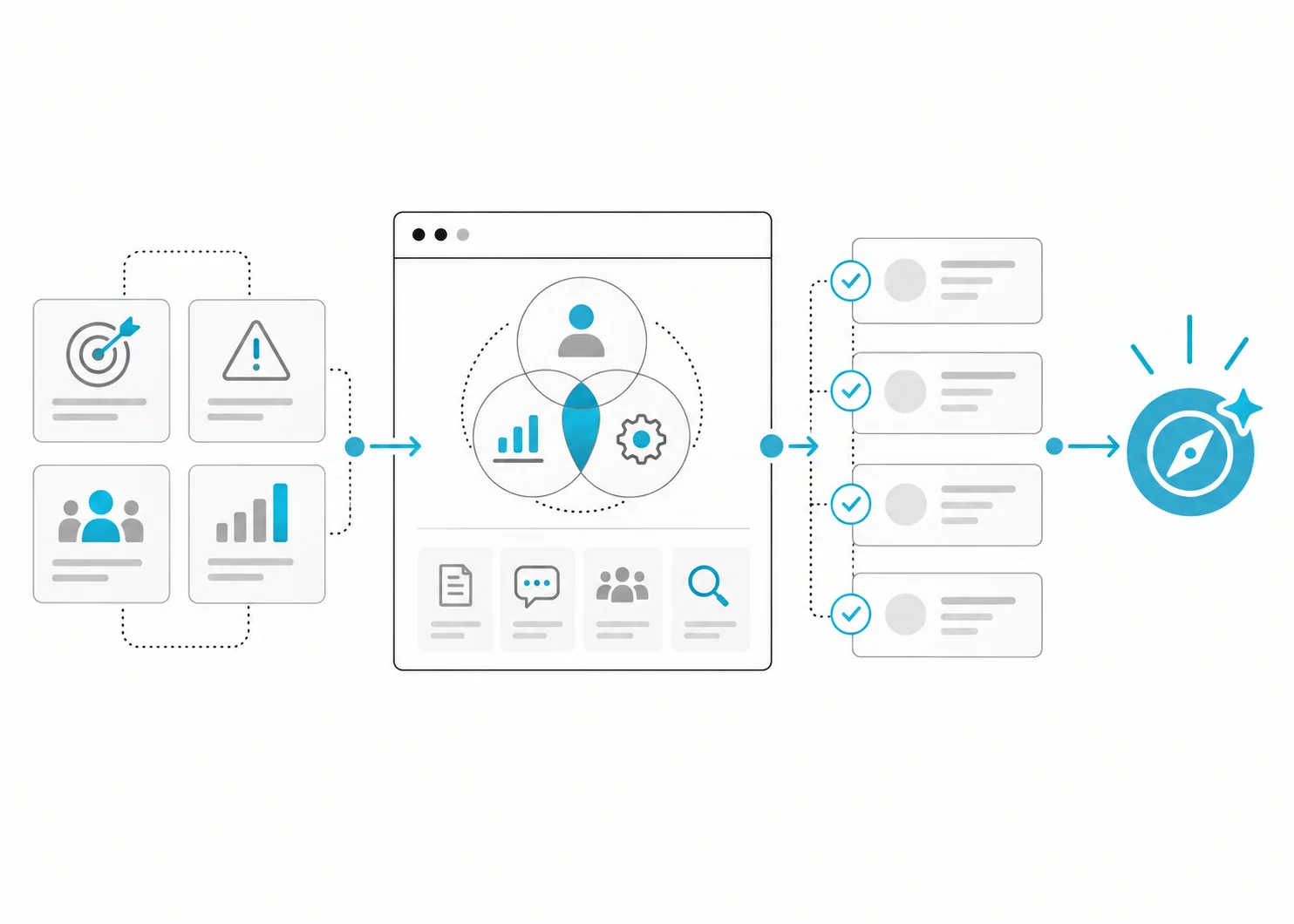
Why do quotes for the "same" AI assistant differ so much?
Because the request describes the screen, while the cost sits behind it. "An assistant that answers questions from our documents" can mean a few thousand clean PDFs in one folder, read-only, for internal staff. It can also mean scanned contracts spread across three systems, permissions that differ for every client team, answers that reach customers, and a rule that nothing leaves the building. The chat window looks the same in both demos. The work behind it does not.
When two suppliers quote very different amounts, the first question is not which one is cheaper but whether they are pricing the same project. A useful quote states its assumptions: how many documents, in which formats, from which systems, for how many users, against what quality target and where the system runs. Without those assumptions you cannot compare the totals, and you cannot hold anyone to them later.
This guide lists the cost drivers of an enterprise AI assistant, shows how model usage turns into a bill, explains how quotes are usually built and ends with a worksheet you can fill in before you speak to any vendor. It contains no prices on purpose. Prices move with exchange rates and vendor price lists; the drivers stay the same.
What are the cost components of an enterprise AI assistant?
An enterprise AI assistant has three kinds of cost: the one-time cost of building it, the recurring cost of running it, and the time of your own people. Budgets usually include the first, underestimate the second and leave out the third.
| Component | What drives it | Kind of cost |
|---|---|---|
| Discovery and scoping | Number of use cases; how clear the success criteria are | One-time |
| Data preparation | Formats, share of scans and tables, duplicates, outdated versions | One-time, partly recurring |
| Connectors and integrations | Number of systems, whether they offer APIs, read-only or also write | One-time plus maintenance |
| Permission model | How permissions are defined at the source and how often they change | One-time plus recurring sync |
| Answer quality work | Size of the test question set, quality target, number of languages | One-time plus re-evaluation |
| Interface and channels | Web app, Microsoft Teams, mobile, messaging, embedding in existing software | One-time |
| Security and compliance | KVKK review, audit logging, security testing, hosting constraints | One-time plus recurring |
| Model usage or licences | Users, questions per day, tokens per question, model choice | Recurring |
| Search and hosting infrastructure | Index size, availability target, cloud or own servers | Recurring |
| Monitoring, support and maintenance | Index refresh, model version changes, incidents | Recurring |
| Rollout and training | Number of departments and sites, user training | One-time |
| Your own team's time | Subject experts for test questions and reviews, IT for access, legal review | Internal |
The FinOps Foundation's FinOps for AI overview makes a point worth repeating to any finance team: AI services are metered differently from ordinary cloud services, their prices change more often, and forecasts need revising more frequently. It recommends unit metrics such as cost per inference, total inference cost divided by the number of requests. For an assistant, a more useful unit is the cost per answered question, because it also captures retries, search and a share of the fixed infrastructure.
How does model usage turn into a bill?
With API-based models you pay per token, with input and output tokens priced separately; with provisioned capacity you pay for reserved throughput by the hour whether you use it or not; with a SaaS product you pay a licence per user.
In a RAG assistant, each question sends the model far more than the question itself: system instructions, the retrieved passages and often the conversation so far. Input tokens therefore usually outnumber output tokens by a wide margin. Anthropic's pricing documentation shows clearly how the pieces interact. Output tokens are priced higher than input tokens. A cache hit on a repeated prompt prefix costs a fraction of the base input price, 0.1 times on most models. The Batch API gives a 50 percent discount for requests that can wait. Restricting inference to a specific geography can carry a multiplier, 1.1 times for US-only inference on recent models. Tool use adds a system prompt of its own, and server-side tools such as web search are charged per use. Other providers structure their price lists differently, but the same questions apply to all of them: what can be cached, what can be batched, and what does data location cost?
Provisioned capacity changes the shape of the bill. Microsoft describes provisioned throughput as dedicated model capacity billed per provisioned throughput unit per hour, regardless of the number of tokens consumed, with discounted reservations for one-month or one-year commitments. Microsoft recommends it for predictable, latency-sensitive, high-volume traffic; standard pay-per-token deployments remain the better fit for variable or low-volume use. For most assistants, the first months run on pay-per-token, and provisioned capacity only becomes a question once real usage has been measured.
A worksheet formula, to fill in with your own measurements and the price list of the model you choose:
- Input tokens per question = instructions + retrieved passages + conversation history + the question itself.
- Output tokens per question = average answer length, including citations.
- Model cost per question = uncached input tokens × input rate + cached input tokens × cache rate + output tokens × output rate.
- Model cost per month = cost per question × questions per active user per day × active users × working days × (1 + share of retries and multi-step answers).
Sending simple questions to a smaller model and only the hard ones to a larger model is a powerful lever on this line; we explain the approach in model routing for cost control.
SaaS licence, cloud API or your own servers: how does the cost shape change?
The three hosting routes do not just cost different amounts; they put the cost in different places and make it grow for different reasons.
| Route | What you pay for | What makes the bill grow | What to watch |
|---|---|---|---|
| SaaS licence per user | Licensed users | Headcount, not usage | Idle licences; limits on connectors and customisation |
| Own application on a cloud API | Build work plus usage | Number of questions, passages per question, model choice | Usage spikes; set budget alerts from day one |
| Self-hosted open-weight model | Build work plus servers with GPUs plus operations | Peak concurrent users, model size, availability target | Capacity sized for the busiest hour; people to run updates and monitoring |
Self-hosting turns a variable cost into a fixed one. Once the servers exist, an extra question costs little, but the servers have to be sized for the busiest hour, kept up to date and monitored, and they cost the same on a quiet weekend. Organisations usually choose it because data may not leave the building, not to save money. If you are weighing these options more broadly, our guide to buying or building AI covers the decision.
Which cost lines do budgets usually miss?
The lines most often missing are those that keep running after go-live: search infrastructure, re-indexing, permission sync, re-evaluation after model changes, human review and compliance upkeep.
- Search infrastructure runs around the clock. In Azure AI Search's dedicated model, for example, the service tier documentation explains that you pay a fixed hourly rate per search unit, that search units are replicas multiplied by partitions, and that adding replicas for availability increases the cost proportionally. The index costs money even on days when nobody asks anything.
- Documents change. New versions, deleted files and new folders have to reach the index, and someone has to notice when the ingestion job fails.
- Permissions change. When people move between teams, the assistant has to reflect it. Permission sync is a recurring job, not a set-up task.
- Models change. Providers retire model versions. Every switch means re-running your question set and sometimes adjusting instructions.
- Review has a cost. If answers feed professional work, someone checks them, and the review screen is part of the product. In Caseon, the LegalTech product Hatson Tech is building for due diligence and contract review, every answer is shown with the document excerpt it relies on, and the lawyer reviews the sources and approves the work. Designing that review flow is a cost line of its own; the Caseon case study shows what it involves.
- Compliance takes upkeep. KVKK's guide on generative AI and personal data expects defined controller and processor roles, information notices, retention periods and, for services abroad, a lawful transfer basis under Article 9. Writing these and keeping them current takes legal and technical time.
- Adoption needs attention. Training, a feedback channel and someone who answers users' questions in the first weeks.
How are quotes formed, and how should you compare them?
A well-formed quote follows the phases of the project: discovery, a pilot with a fixed scope, phased development and maintenance, with each phase priced after the previous one has reduced the uncertainty. A single all-in total before anyone has opened your documents usually means either a large margin for the unknown or a renegotiation later.
Use this checklist when you put two quotes side by side:
| Question | Good sign | Warning sign |
|---|---|---|
| Are the assumptions written down? | Document counts, formats, systems, users and hosting are listed | "An AI assistant for your documents" and nothing more |
| Is success measurable? | Acceptance is tested on a question set you help write | "High accuracy" with no test set behind it |
| Who pays for model usage? | Usage is estimated separately, with the formula behind it | Usage hidden inside the total or described as unlimited |
| What is excluded? | Exclusions are listed, for example scanned archives or write access | No exclusions at all |
| Who owns what? | You own the code, index configuration, instructions and test set | Ownership not mentioned |
| How are changes handled? | A written change process | Changes agreed only verbally |
| What does maintenance cover? | Index refresh, permission sync, model changes and response times | "Support included" |
| Can you leave? | Data export and handover are described | No exit terms |
Cost-driver worksheet
Fill in the last column before your first vendor meeting. Every answer that lands closer to the "more effort" column moves the project towards a larger scope. Seeing that early, in your own words, is the point of the exercise.
| Driver | Less effort | More effort | Your situation |
|---|---|---|---|
| Document volume | Thousands | Hundreds of thousands | |
| Formats | Born-digital text | Scans, handwriting, complex tables | |
| Sources | One repository | Several systems, some without APIs | |
| Access | Read-only | Also creates or changes records | |
| Permissions | Department level, stable | Per document or per client, changing often | |
| Users | One department | Whole company, several sites | |
| Languages | One | Turkish and English, mixed terminology | |
| Who reads the answers | Internal staff | Customers or regulators | |
| Quality bar | A useful draft with citations | Reviewed output used in decisions | |
| Hosting | Cloud is acceptable | Must stay on your own servers | |
| Availability | Office hours | Around the clock | |
| Channels | One web app | Web, Teams, mobile and messaging |
Hypothetical example: the same request, two different projects
This is a hypothetical example to show how the drivers work; it contains no real figures. Two companies send the same one-line request: "an assistant that answers staff questions from our documents".
Company A has about 3,000 policy and procedure documents, all born-digital, in one SharePoint site with department-level permissions. Two hundred office staff will use the assistant, the legal team has approved cloud processing, and answers stay internal with citations. Almost every row of the worksheet lands in the "less effort" column.
Company B has twenty years of contracts and correspondence, much of it scanned, spread across a document management system and network shares. Permissions follow client teams and change every month. Answers must also look up order data in the ERP, the legal team requires contract data to stay on the company's own servers, and some answers will be sent to customers after review. Most rows land in the "more effort" column.
Company B's project needs OCR and table handling, two extra connectors, a permission sync, a self-hosted model sized for its busiest hour, a review screen and a larger question set. Its quote will be considerably larger, and it should be. Comparing A's quote with B's request, or the other way round, is how buyers come to believe that AI pricing is arbitrary.
The usage line differs too. Suppose, purely for illustration, that each answer sends about 1,000 tokens of instructions, five passages of about 400 tokens each and the question, and returns an answer of about 300 tokens. Plugged into the formula above, the instructions are the obvious caching candidate because they repeat on every request, and the passages are the main lever: retrieving five well-chosen passages instead of fifteen loosely related ones cuts the input, and the test question set shows whether the answers suffer. Company A pays this per question to a cloud API. Company B pays instead for servers sized for its peak, and its marginal cost per question is small once they are running.
How can you lower the cost without lowering quality?
- Start with one department, one or two clean sources and read-only access. Add writing to other systems in a later phase.
- Write the test question set first. It stops you paying for features nobody asked for.
- Cache what repeats, batch what can wait and route simple questions to a smaller model.
- Measure the cost per answered question during the pilot, and set budget alerts on usage.
- Leave archives with no business value out of the index; they cost money to process and add privacy risk.
- Measure the benefit as carefully as the cost. Our article on measuring AI return on investment shows how to set a baseline before go-live.
How does Hatson Tech price an assistant?
We have no fixed price list for assistants and we do not promise a fixed total before the sources have been examined. The first meeting and the discovery work for a software project are free. Discovery answers the questions in the worksheet above: which documents, in which systems, under whose permissions, for which users and where the assistant must run. After it, scope, deliverables, acceptance criteria and the assumptions behind them go into a written quote, and each later phase is quoted the same way. Details are on our enterprise RAG and semantic search page. If you already hold quotes from other suppliers, the comparison checklist above works just as well without us.