

What Makes a System Multi-Agent?
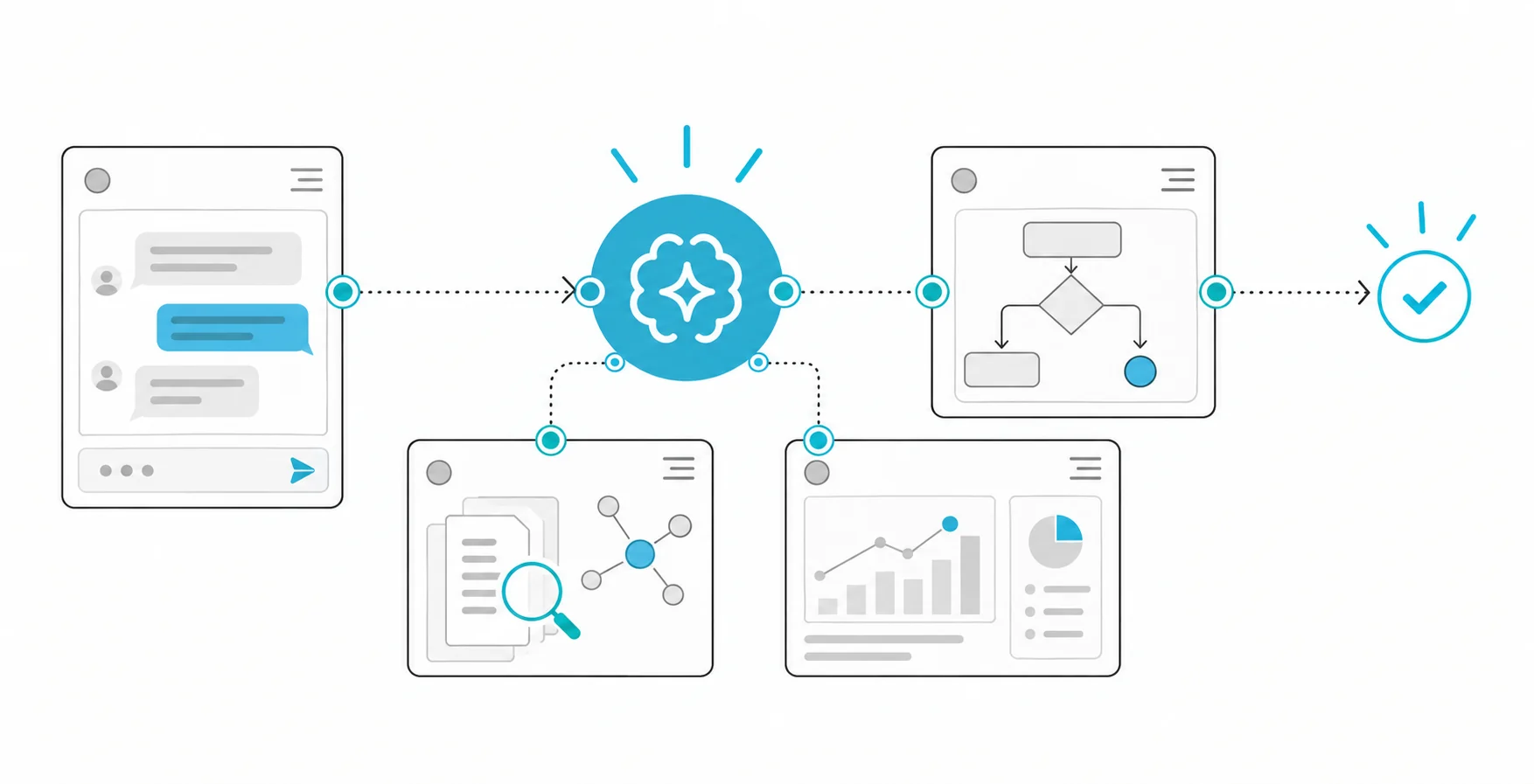
A multi-agent system lets more than one model-driven worker use tools or reason through separate parts of a task. A coordinator may assign work, track results, and combine the outputs. The useful distinction is independent work: if every step depends on the previous step, a simple sequence of calls may be easier to operate. Anthropic describes an orchestrator-worker design in its account of building a research system, where parallel workers explore different information sources.
A Research Example You Can Evaluate
Imagine a procurement team comparing three document management products. One worker reads each vendor's current technical documentation, another checks pricing and contract terms supplied by the vendors, and a third searches for integration constraints in the buyer's existing systems. The coordinator receives a short report from each worker with source links and unresolved questions. It then produces a comparison table and asks a human to verify any contract interpretation. This is a hypothetical workflow, not a description of a Hatson Tech customer deployment.
The workers can run in parallel because their evidence gathering is mostly independent. Asking three agents to rewrite the same paragraph would add cost without creating new evidence. A sequential pipeline such as retrieve → summarize → format is often a workflow, not necessarily a reason to create multiple autonomous agents.
When One Agent Is Enough
Start with one model call or one agent and a clear tool set. If the task is narrow, the evidence fits in context, and the answer can be checked with deterministic code, extra agents may increase latency and failure paths. Multi-agent work is more promising when independent searches can proceed at the same time, when each worker needs a separate context or tool permission, or when the combined task exceeds one agent's practical context budget. Anthropic's published results concern its own research workloads; they do not prove the same gain for another company's tasks.
How to Measure the Trade-off
Build an evaluation set from representative, permissioned tasks. Include easy cases, conflicting sources, missing information, and tasks with no useful parallel split. Compare a single-agent baseline and a multi-agent version on answer correctness, source support, completion time, total tokens, tool calls, and human review effort. Count failures where the coordinator loses a source, workers duplicate work, or one worker's error becomes the final answer. Keep trace IDs so a reviewer can follow each claim back through the workers. If a multi-agent design still looks justified after this test, our AI agent development page explains how we scope and build it.
Do not treat an agent criticizing another agent as independent verification. Both may share the same mistaken source or model bias. For high-stakes outputs, verify against original documents or deterministic checks, and give the human reviewer the evidence. Anthropic's agent evaluation guide offers useful methods for designing such cases.
Sources
- Anthropic: How we built our multi-agent research system — architecture, costs, and suitable parallel tasks.
- Anthropic: Demystifying evals for AI agents — evaluation design and traces.